The Wisdom of Crowds? – A Mid Year Review
Summary
One task keeping human sellside analysts busy for now is the production of mid-year outlooks forecasting the path of asset classes and macro variables. For this note, we used LLMs to extract key views and sentiment from a sample of mid-year broker reports, which we treat as a ‘wisdom of crowds’ anchor for discussing key themes and risks for the balance of 2026.
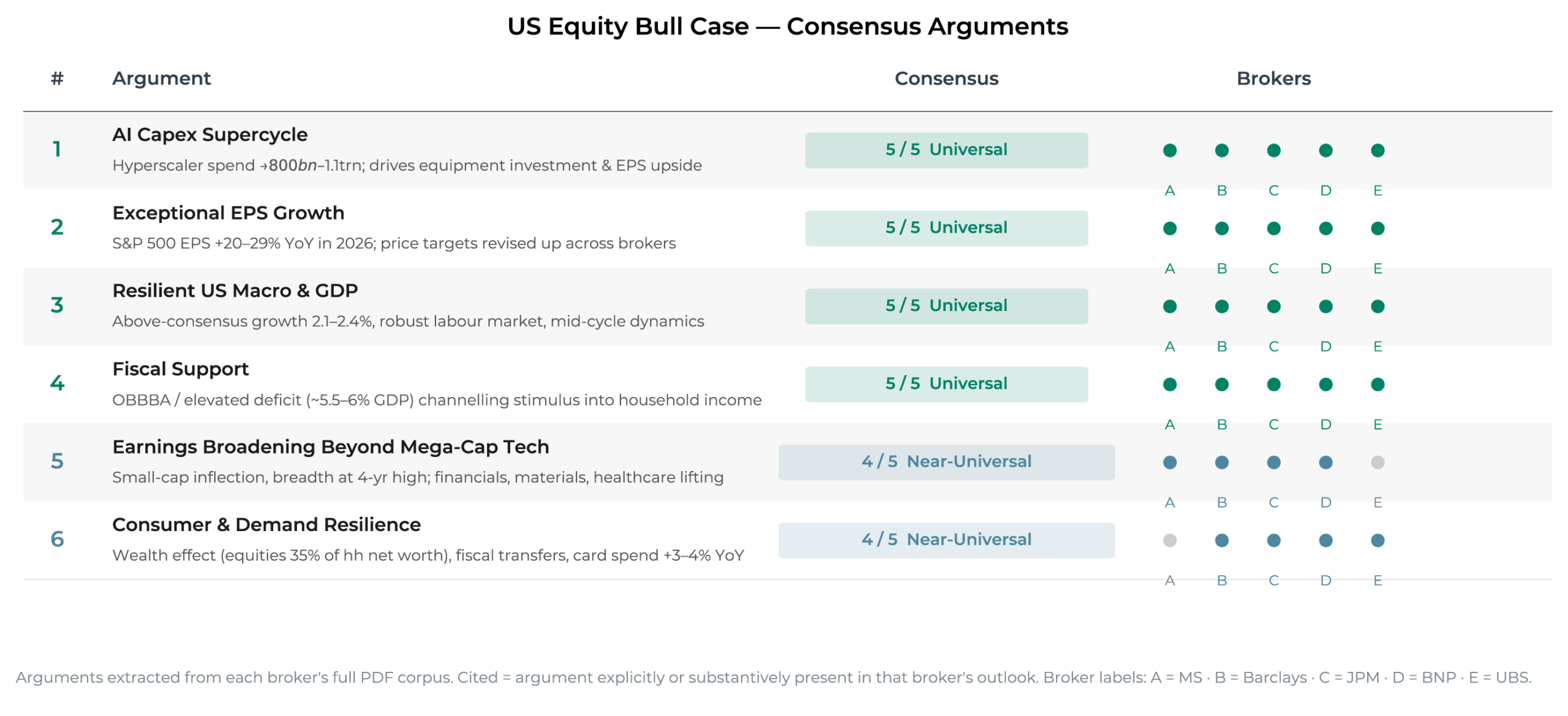
Consensus, especially from the sellside, tends to shift with the latest narratives as research notes adapt to short-term client flows. Unsurprisingly, the majority expect continued equity strength into year-end, with bullishness centered on the US and its lead in AI. We also see a majority expecting higher US yields for the balance of 2026: a consensus statement on the growth and inflation mix in the United States.
Where is the Consensus?
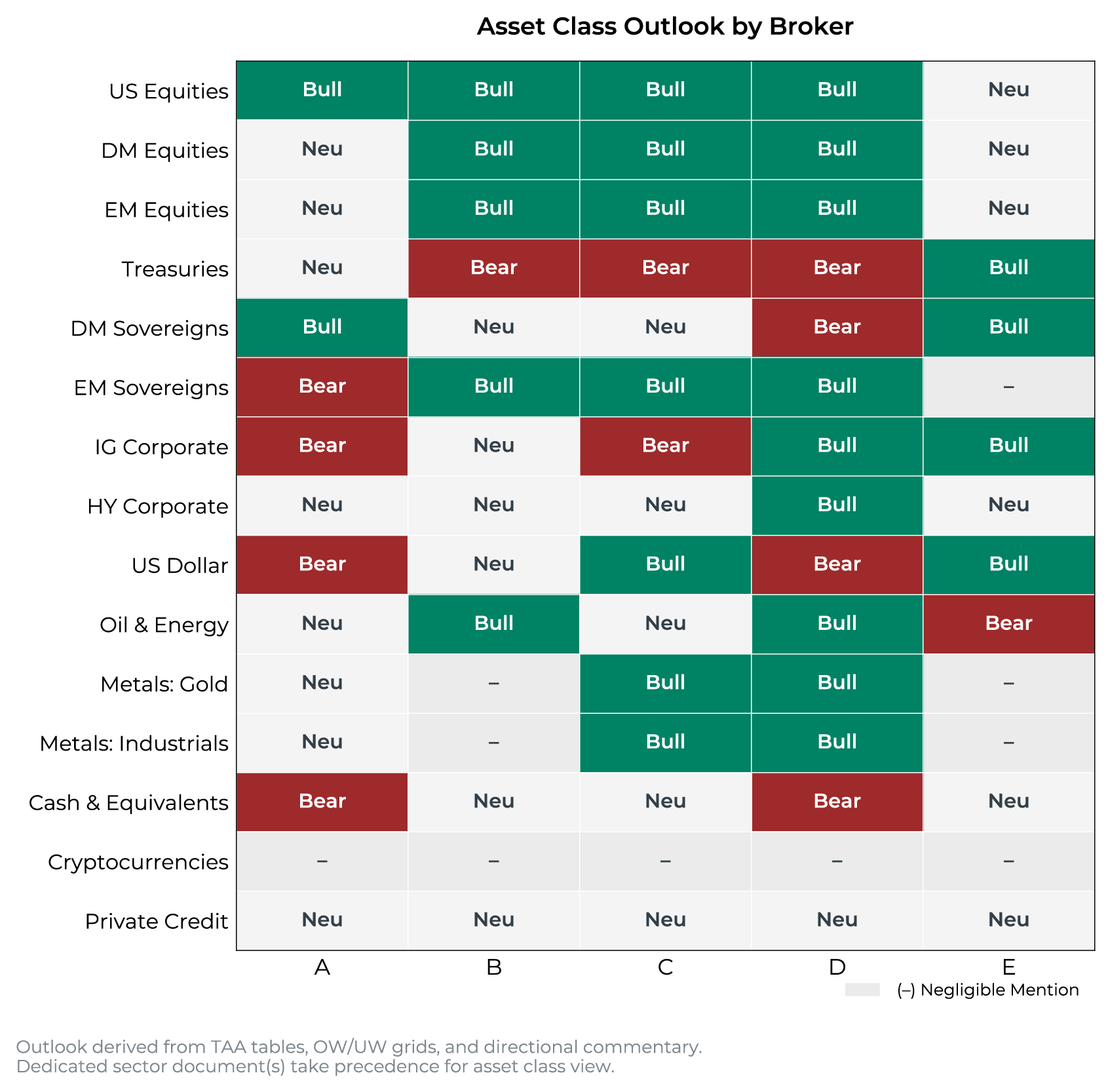
Asset classes. Equity risk is the clearest consensus, with US equities almost unanimously bullish and DM and EM leaning the same way. Rates run the other direction: Treasuries are broadly bearish, consistent with the higher-yields view. Conviction fades in credit and FX, where views on IG corporates and the US Dollar are mixed. Cash is unloved, gold and industrial metals are constructive where covered, and cryptocurrencies draw no meaningful opinion.
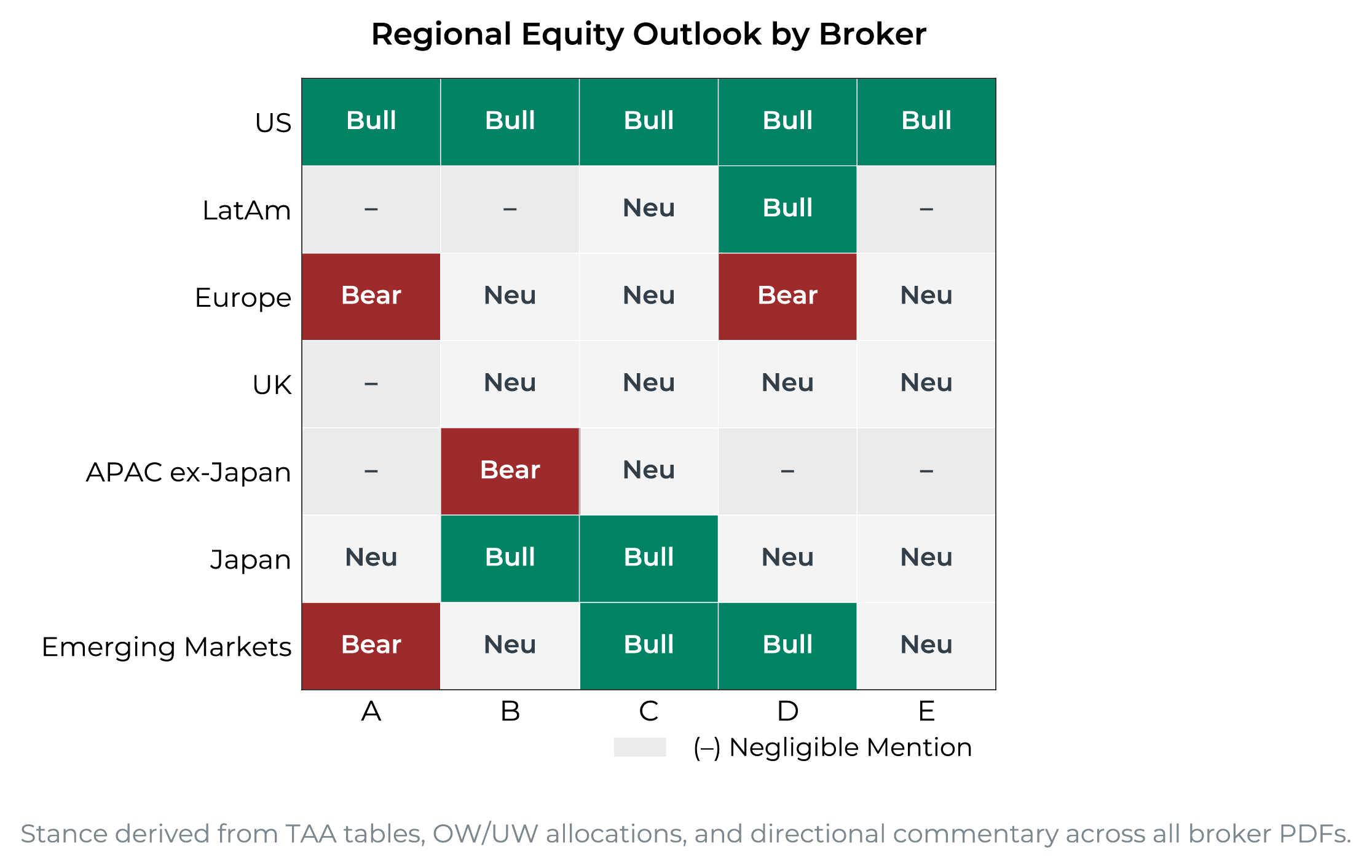
Regions. The US is the one unanimous call. From there, conviction thins quickly: Emerging Markets and Japan lean mildly positive, both with pockets of AI exposure, though without broad agreement. Europe stands out as the clear laggard, attracting bears and no bulls. The UK and APAC ex-Japan are largely an afterthought.
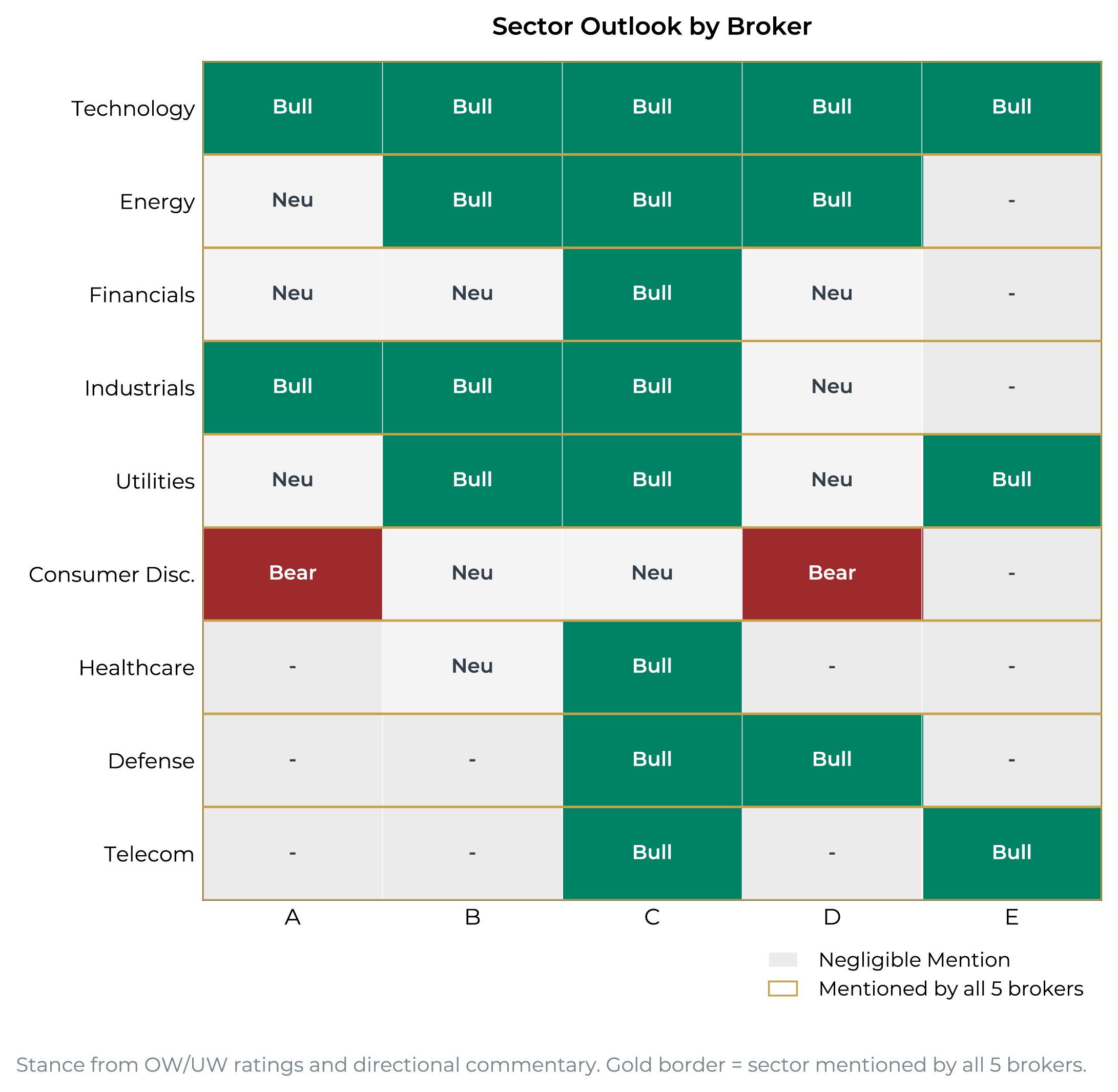
Sectors. Technology mirrors the US equity call; uniformly bullish and the only sector every broker covers. Energy and Industrials follow, with Utilities also favored; both Utilities and Industrials have exposure to the AI buildout. Coverage thins after that, and Consumer Discretionary is the sole sector drawing any bears.
AI the Everything Trade
AI is a general purpose, disruptive technology impacting markets broadly. The consensus correctly flags US equities as the primary beneficiary, along with a mix of Asian equity markets. The reach of AI runs deep, with each link in the demand-supply chain impacting different segments of the market. The stronger the moat around a particular link, the more pricing power it holds, raising the input and buildout costs to deploy the technology.
This year, the market rationally rewarded firms that directly benefit from the massive spending required to deploy the technology but not the spenders. We see this in the year-to-date outperformance of the Nasdaq (+18%) versus the Magnificent 7 (+1.95%)1 . Hyper-scalers make up the bulk of the M7, and with over a trillion in projected capex2 this year and next, the market is re-rating the outlook for earnings, cash flow, dividends and buybacks against a lack of clarity that killer use cases will emerge to justify the return on invested capital.
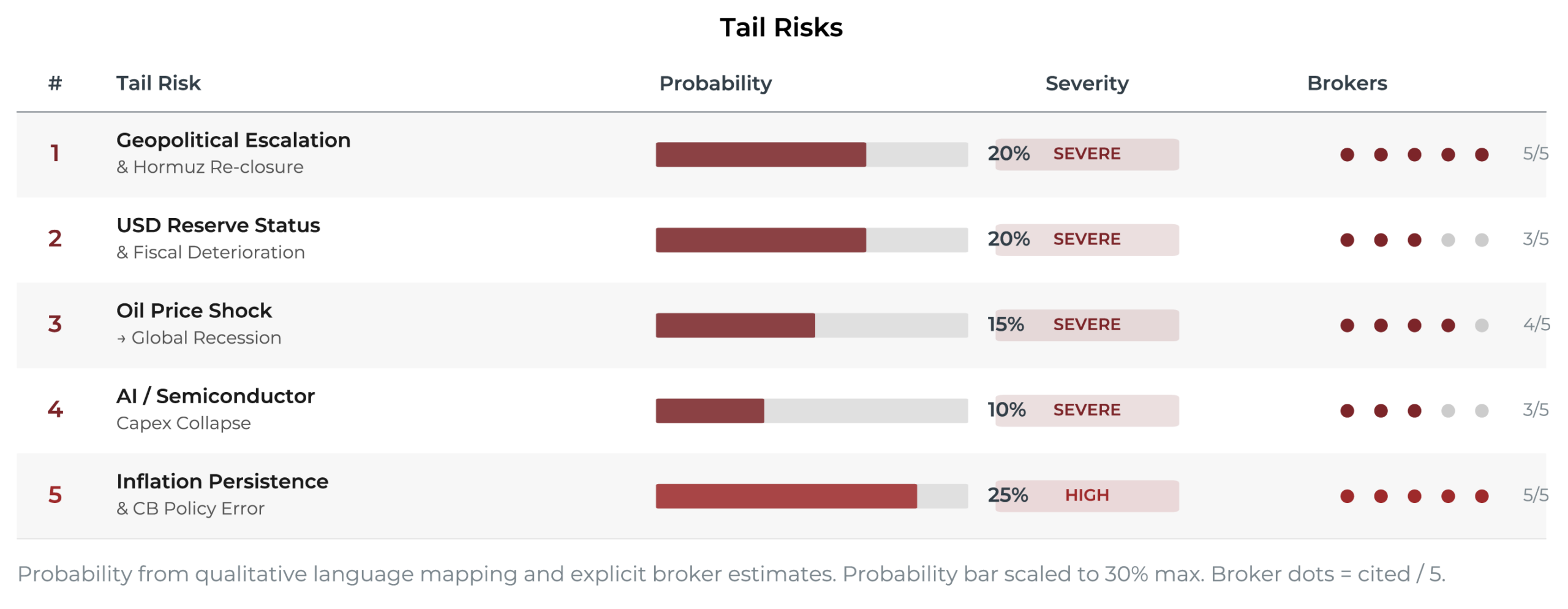
One major tail risk flagged in our broker sample is ‘capex collapse’, which would reverse the outperformance of spending beneficiaries versus spenders. This is likely less of a concern for those holding broad indices but a danger for active managers, both discretionary and quantitative, that risk being offside during severe rotations within the index.
The acceleration of the technology is impressive. Only a year ago we were joking about its inability to count the number of ‘r’s in ‘strawberry’; today it has, for example, redefined the role of experienced coders, with key tasks shifting to creativity and ideation (defining the inputs for LLMs to code) and validation (assessing the quality of the output). The technology is so general that we expect its impact on sectors and employment to run for years. How value accrues will shift over time, across infrastructure providers, model providers, the application layer, and ultimately customers. Expect that mix to keep changing, creating opportunities for investors.
What about profitability? We prefer not to underestimate ingenuity, as high margins and scale attract new entrants (Chinese models, for example), new ideas (mixture of experts; models scheduling the level of intelligence to deploy) and investment (into the most bottlenecked links). We expect cost-per-token-per-watt to continue declining as innovations in hardware, software and network architectures evolve, in part with help from LLMs themselves. We also suspect it will take time for firms to adapt to the technology and understand how best to leverage it to improve productivity and profitability. When electricity, another disruptive technology, was first introduced, factory design was still built around the steam engine; it took decades for firms to redesign around it and capture the gains.
As for the consensus, our broker sample appears directionally correct. We expect the AI theme to continue for the balance of the year. Earnings have re-rated significantly, but the market is still underestimating three things: the scale of spending and upward pressure on input costs; the steepness of technology curves and the pace of innovation; and, in turn, the improvements in costs and accelerating corporate adoption these should drive. Expect record earnings from firms with the strongest moats and pricing power, and continued growth support for economies benefitting from AI.
Consensus Macro Backdrop
Consensus now backs US outperformance, a sharp reversal from the start of the year when US exceptionalism was under pressure and capital rotated steadily out of the dollar and US equities into rest-of-world assets. European themes, including increased deficit spending (e.g. German defense), lifted equities, pushed European yields higher on a deteriorating fiscal trajectory, and supported the euro. That equity and FX outperformance reversed sharply on the Middle East crisis, as Europe and Asia are more exposed to an energy shock than the United States.
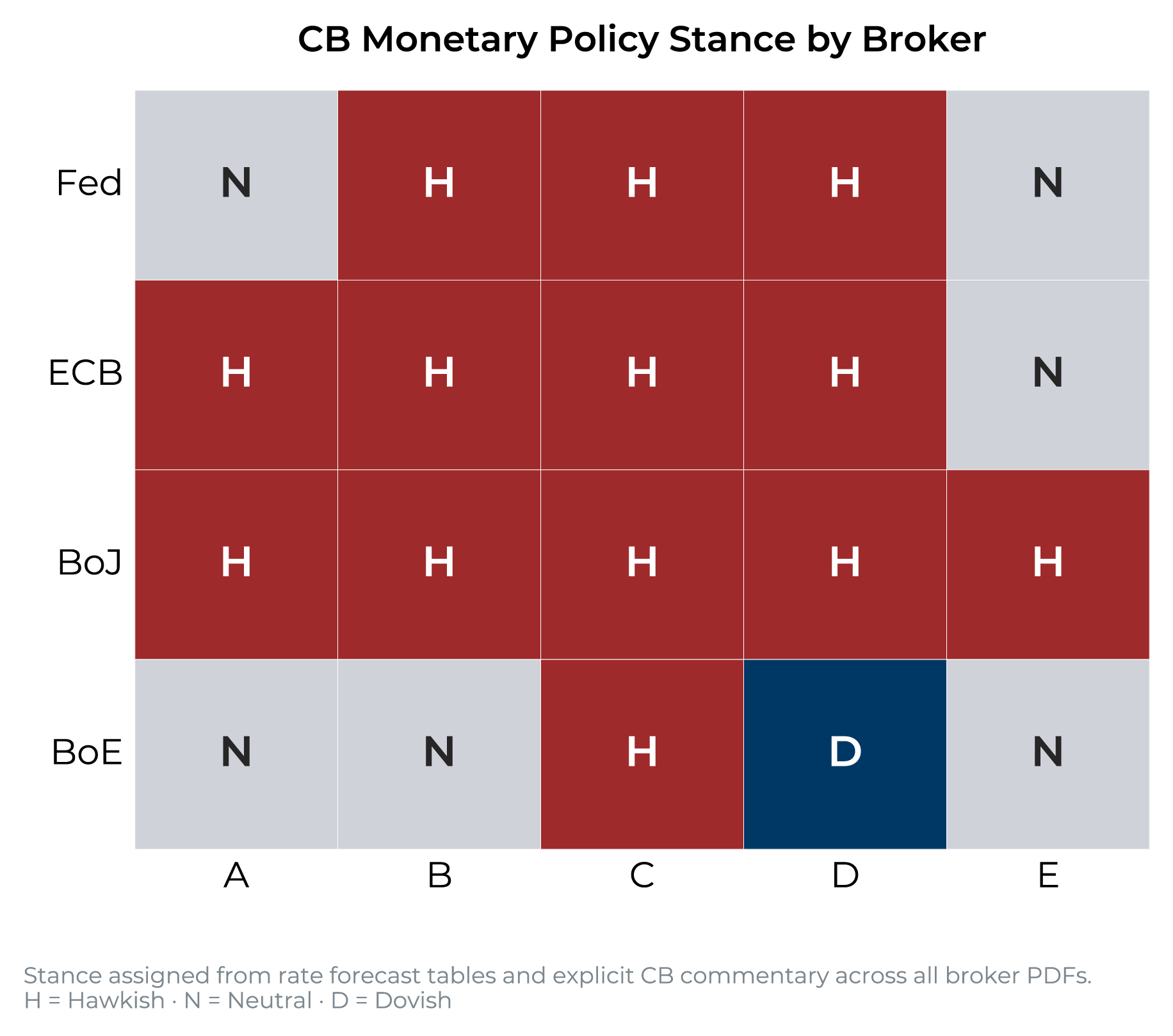
The US is running a ∼7% deficit3 , and the Trump Administration’s tax cuts, spending and lighter regulatory touch are fueling animal spirits and risk assets. We also have a new Federal Reserve Chair, Kevin Warsh, who favors less official communication and a larger role for markets in pricing, a recipe for more rate volatility as the Fed’s forward guidance is withdrawn. Notably, the market expected a Chair willing to cut rates for the Administration, while we expect a more pragmatic Fed Chair who will defend the Fed’s inflation target. The AI buildout is a strong support to US growth, and we expect inflation pressures to persist as AI’s insatiable demand for resources feeds knock-on inflationary impulses. Consumer electronics are one example: prices for computers and devices are rising as key inputs like memory see significant inflation. The potential productivity gains and deflationary impulse from AI can only diffuse once the cost-per-token-per-watt curve declines sufficiently, a theme for another year.
The consensus view on US duration looks reasonable against this backdrop. Mixed views on non-US duration reflect the idiosyncratic growth and inflation mix in each region. European growth remains soft and we are starting to see pushback on fiscal spending, including its composition. Japan, under Takaichi, is resurrecting Abenomics but faces binding constraints via downward pressure on the Yen (-3.27%) and its bond market (10y JGB +68bp), while the Nikkei (+36.2%) and Topix (+18.4%)4 have benefitted from the AI theme.
On the dollar, we lean more bullish than the divided consensus. The same factors the sellside is bullish on, US growth leadership and the AI theme attracting global capital, support a firmer dollar, not a weaker one. The United States is also better insulated from further energy disruptions given its position as a net energy exporter, another support for the dollar.
Potential Tail Risk
Our broker sample converges on the obvious: geopolitical escalation and inflation persistence top the list, each flagged by all five. Consensus on any risk, though, usually means it is at least partially priced. We are more interested in how those known risks actually transmit to portfolios, and in the ones the sample overlooks.
Known Unknowns: The Middle East ceasefire is an unstable equilibrium. Facing inflationary pressures, a drawdown of the Strategic Petroleum Reserve, and deteriorating poll numbers on the economy heading into the November midterms, the President was forced into a ceasefire of convenience. The uncomfortable lesson is that choking off energy supply is now a form of warfare: cheap and effective in unstable regions. It remains a source of negotiating leverage going forward, which keeps the odds of disruption to global energy markets higher than currently priced, even with a ceasefire in place.
Unknown Unknowns: As AI improves, the risk of cyberwarfare rises. Some argue the constraints imposed on recent model releases from Anthropic and OpenAI are just hype ahead of potential public listings. The reality is more nuanced: the latest models show a strong ability to identify vulnerabilities in software stacks. In the hands of bad actors, this raises risks to global technology stacks, the financial system included. These risks have already been flagged by the US Treasury and various central banks.
Key Takeaways
- AI is the dominant theme and we think the consensus long is likely directionally correct. The market still underestimates the scale of spending, the pressure on input costs, and how fast the cost-per-token-per-watt curve falls.
- The market rewarded beneficiaries over spenders this year. How value accrues will keep shifting across the infrastructure, model, application and customer layers, creating a moving set of opportunities. ‘Capex collapse’ is a minor risk for index holders but a real one for active managers exposed to intra-index rotations.
- The macro backdrop supports US risk assets: a ∼7% deficit, animal spirits, and the AI buildout underwrite growth, while AI’s demand for resources keeps inflation pressures alive (e.g. memory and consumer electronics).
- We expect a more pragmatic Warsh Fed than the market, one that defends the inflation target rather than cutting for the Administration, pointing to more rate volatility and higher long-end yields.
- We are more constructive on the dollar than the divided consensus, on US growth leadership, the AI capital magnet, and net energy-exporter insulation. Europe, by contrast, looks like the clear laggard as its energy and fiscal tailwinds fade.
- The agreed risks (geopolitics, inflation) are partly priced; the ignored ones are not. The Middle East ceasefire is unstable and keeps energy-disruption risk higher than priced, while AI-enabled cyberwarfare is a neglected tail risk.
1 As of July 10th, 2026
2 Source: Bloomberg
3 Source: Bloomberg
4 As of July 10th, 2026
Disclaimer
Any statements regarding market events, future events or other similar statements constitute only subjective views, are based upon expectations or beliefs, involve inherent risks and uncertainties and should therefore not be relied on. Future evidence and actual results could differ materially from those set forth, contemplated by or underlying these statements. In light of these risks and uncertainties, there can be no assurance that these statements are or will prove to be accurate or complete in any way. All opinions and estimates included in this document constitute judgments of CFM as at the date of this document and are subject to change without notice. CFM accepts no liability for any inaccurate, incomplete or omitted information of any kind or any losses caused by using this information. CFM does not give any representation or warranty as to the reliability or accuracy of the information contained in this document. The information provided in this document is general information only and does not constitute investment or other advice. The content of this document does not constitute an offer or solicitation to subscribe for any security or interest.