Real, But Not Settled
There’s a well-packaged argument doing the rounds regarding the recent jump in long-term US government bond yields, that there is nothing to worry about1 . It says there’s no real concern about US debt, and no loss of faith in the Federal Reserve. It walks through a standard way of breaking down interest rates and comes out with a reassuring answer, which is baked into the method from the start.
Here’s the argument in plain terms: A bond yield can be split into two parts: how much of the return is “real” and how much is just compensating investors for expected inflation. The comforting argument makes four claims:
- 1. Inflation expectations are calm. Markets still expect inflation around 2%. Hence this isn’t a story about people losing faith in the Fed’s ability to control inflation.
- 2. Therefore, the rise must be in the “real” part of the yield.
- 3. That real part can be split into what investors expect short-term interest rates to average over the coming years and an extra cushion called the term premium (the reward investors want for locking their money up for a long time). If people were worried about government debt, the argument says, you’d see it in that term premium.
- 4. But the term premium has been steady. So, the rise must be coming from investors expecting higher interest rates in the future, which, the argument concludes, means they’re betting on stronger economic growth from AI, deregulation and tax cuts. Growth is good, nothing to worry about.
The first two claims are fine, and we’ll accept them. The rise really is in the “real” part, and inflation expectations have remained well anchored. It’s the last two claims where things go wrong.
Problem 1: excessive issuance may not turn up in term premium
The argument assumes that if markets were nervous about US debt, it would appear in the term premium, the long-term cushion. Thus, when the term premium looks calm, it concludes there’s no debt worry.
The reality is different. When a government borrows huge and growing amounts, the most direct effect is to push up interest rates – more borrowing means the government is competing with everyone else for a finite pool of savings, which drives up the real cost of borrowing across the economy. Crucially, whether that pressure shows up as “higher expected future short rates” or as “a higher term premium” is itself a matter of model interpretation (see Problem 2) – the decomposition can’t cleanly assign it. The comforting argument assumes optimistic reading: it sees “investors expect higher rates ahead” and takes it as excitement about growth. But nothing in the argument separates the two effects. Higher expected rates could reflect optimism about growth, or simply a belief that sustained deficits drive up borrowing costs and keep them elevated for years.
Problem 2: the “steady term premium” isn’t a fact you can look up
This is the part that really matters, because the whole argument leans on it.
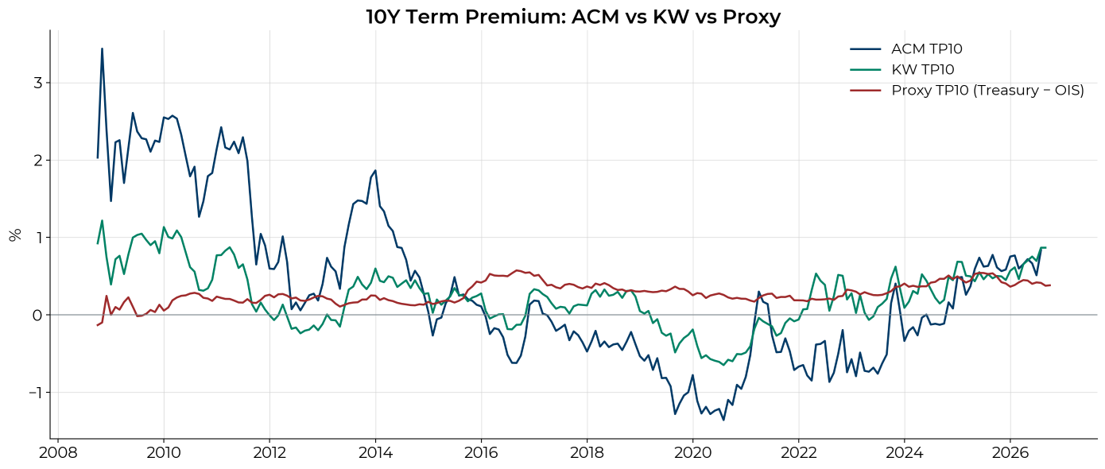
We can’t actually observe the term premium directly. It’s one of those quantities economists have to infer rather than measure. The model first needs an estimate of what investors expect interest rates to do, and a different estimate produces a different term premium.
So how reliable is “the term premium has been steady”? Not very. The standard models and the market-based proxy, treasuries against OISs, don’t even agree on which direction it has moved recently: some point up, the proxy points down.
So “the term premium has been steady” isn’t an observation. It’s the answer from one particular model, and only as solid as that one model choice, which is to say, not very.
It is also worth noting that the future path of rates has been somewhat muddied by Kevin Warsh’s push back against forward guidance. A determination of term premium relies on a good forecast of future rates, but Chairman Warsh has made that job more difficult and perhaps even more model dependent.
Now step back and look at the shape of the whole argument
Rising yields? Growth optimism. Calm inflation expectations? The Fed’s fine. Steady term premium? No debt worries. Notice that there’s no version of the data this argument would ever read as a warning. Whatever the numbers do, the answer comes out “everything’s fine.” That’s the tell: an argument that can only reach one conclusion isn’t diagnosing the bond market; it’s reassuring you about it.
A more objective view can only be less dogmatic. Rates have risen, it’s real, inflation is steady, but the why is genuinely up for grabs, read variously as optimism about AI and growth, a return to a normal cost of money, or nervousness about government debt.
Holders of government paper have varying degrees of elasticity or price sensitivity. Foreign holders (generally price insensitive) of US debt are going in the opposite direction and many a news article describes foreign reserves flowing into the gold market as an alternative store of value and source of liquidity (the recent rise in gold prices hints at this). The slack has been taken up by more price sensitive buyers who do require a higher reward for holding more diluted paper. Hyperscalers are also starting to compete for savings to fund their extraordinary Capex spend, which does have the potential to drive long rates higher and compete with US treasury issuance.
The easy explain on the shift up in long rates is oversimplified by the statement “the economy is stronger” rather than “the world is being asked to hold more government debt”. Both effects push real rates higher, but the numbers can’t say which dominates.
1 See Stephen Miran in the FT
Disclaimer:
Any statements regarding market events, future events or other similar statements constitute only subjective views, are based upon expectations or beliefs, involve inherent risks and uncertainties and should therefore not be relied on. Future evidence and actual results could differ materially from those set forth, contemplated by or underlying these statements. In light of these risks and uncertainties, there can be no assurance that these statements are or will prove to be accurate or complete in any way. All opinions and estimates included in this document constitute judgments of CFM as at the date of this document and are subject to change without notice. CFM accepts no liability for any inaccurate, incomplete or omitted information of any kind or any losses caused by using this information. CFM does not give any representation or warranty as to the reliability or accuracy of the information contained in this document. The information provided in this document is general information only and does not constitute investment or other advice. The content of this document does not constitute an offer or solicitation to subscribe for any security or interest.