Optimists vs Pessimists
Optimists vs Pessimists 1
One of the biggest risks to global portfolios is the AI trade. The theme has a long reach, touching economic growth, global equities and sectors, rates, credit, commodities, infrastructure and real estate exposures embedded in well-diversified portfolios. A loss of confidence in the theme would destroy trillions of dollars of value accrued across global portfolios.
The world’s two leading AI labs are planning IPOs in the coming months. Anthropic is expected to IPO later this year at a $2tn valuation.
The pessimists say it’s a bubble and that these firms will never achieve scale or profitability. They argue most of the framing is hype designed to extract rich valuations ahead of the IPO. They highlight the circular investment relationships between labs and hyperscalers, the enormous borrowing required (including off-balance sheet arrangements) to fund the trillions in capex, and the well-placed stories about models getting so good they create national security risks, implying superintelligence is just around the corner. They also point out the lack of profitable use cases or adoption outside narrow fields and the inefficient token production that leads to hallucinations, overconfidence and AI slop.
The optimists say the technology is revolutionary and will continue to scale. They argue profitability is around the corner and will arrive as investment ramps up, driving huge gains in productivity for virtually every sector of the economy and supercharging economic growth. It will also revolutionize scientific research and lead to exponential growth in discoveries that benefit humanity: new drugs, new physics, new materials, and better optimization of systems, processes and code, all created by an ever-improving machine intelligence.
In this note, we do some back-of-the-envelope math to examine the rough economics of compute investments. One observation before we start: for the longest time, the hyperscalers could not find interesting investments and instead preferred to repurchase stock and pay dividends. Now, they are willing to take on trillions in investment to build a new technology. These are some of the most successful, well-run companies in the world, and the decision to invest heavily in AI signals strong conviction in the technology’s ability to scale and deliver profitability.
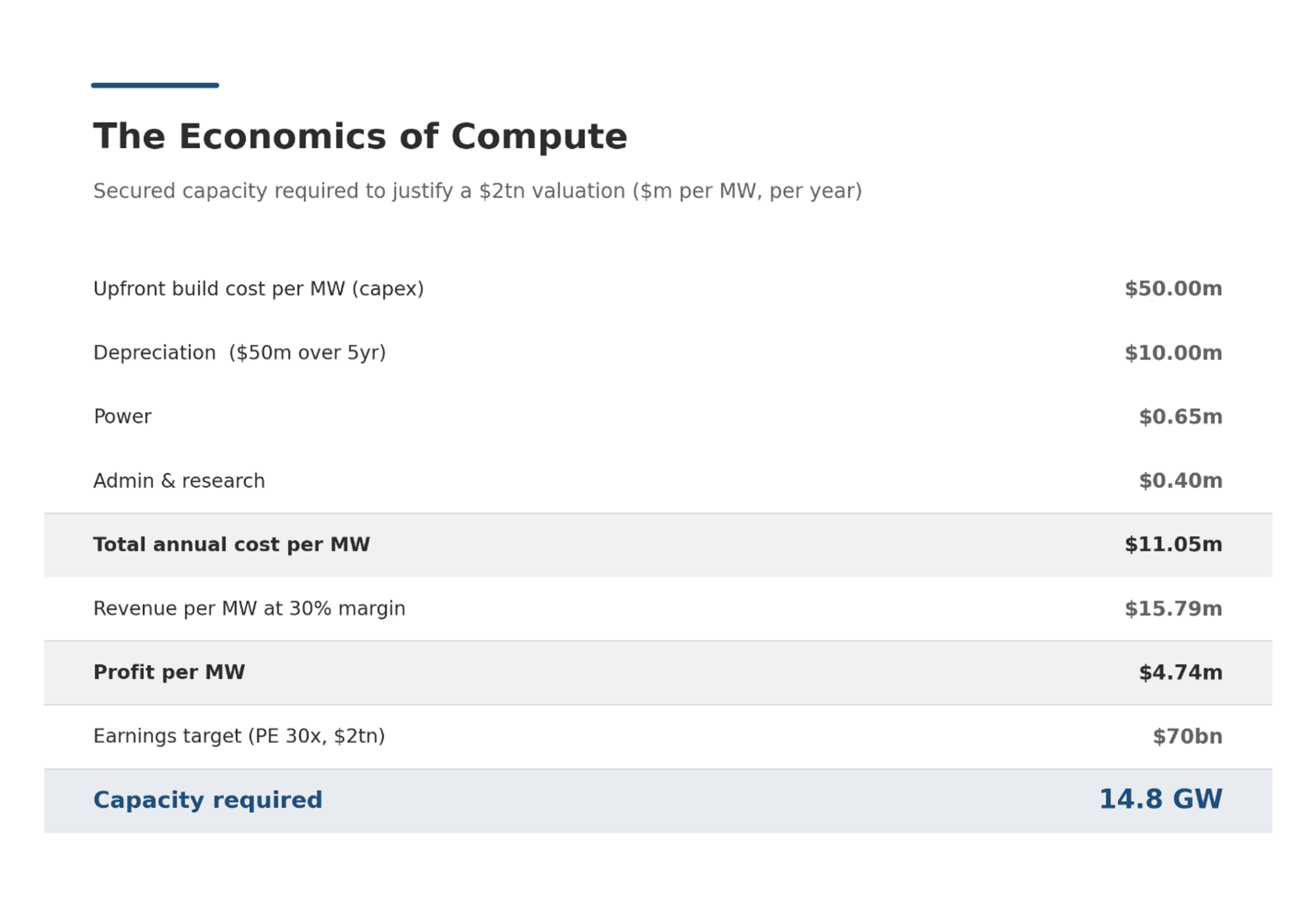
Last year, Jensen Huang suggested the all-in cost of building a datacenter was roughly $50m per megawatt, and the figure has risen since2 . These upfront costs are amortized over the life of the asset. We also need to operate the datacenter, and running costs include power and administration, including the cost of all the researchers pushing the technology forward. Once our compute is in place, we need to monetize it. We can use it for two tasks: training new models that get better and command higher prices, and serving up existing models. Training locks up compute and defers revenue, while serving models generates immediate revenue. Innovation is also rapid: the addition of an incremental megawatt of compute produces more tokens than the prior megawatt, allowing our lab to do more training, scale model hosting and release better models.
Anthropic recently paid SpaceX $50m per year per megawatt to lease compute for inference. The agreement has optionality: Anthropic can terminate the lease in the short run. The significant price inflation, versus the cost of secured but not yet online compute, highlights the severe shortage of compute. From SpaceX’s perspective, leasing compute at these prices pays for itself in a little over a year, an interesting proposition for anyone with an installed compute base but no frontier models of their own. It also implies Anthropic can generate sufficient margins on this higher priced compute by training or serving models relative to our baseline assumptions. There are clear benefits to scale in the industry, with the leading labs willing to pay more for compute than competitors to speed up the flywheel.
In their most recent filing, Anthropic disclosed annual recurring revenue of $65bn and a small operating profit3 . They also disclosed a total addressable market (TAM) of roughly $30tn, the entire US economy, arguing that AI is so general it will touch every corner of the economy. These figures show that AI is already being monetized at significant scale, though the economics remain highly capital-intensive and Anthropic has yet to demonstrate sustained profitability at scale.
How do we get to a $2tn valuation? SpaceX has already shown this is possible for companies with small revenue relative to the scale of their anticipated future markets. SpaceX listed at a $1.7tn valuation, roughly 95 times its 2025 revenue, despite substantial current investment requirements and operating losses. That valuation relies on expectations of strong future growth across Starlink, launch, connectivity and AI infrastructure. If investors are willing to apply similarly high revenue multiples to frontier AI companies while absorbing market, regulatory, technology and capex risk, Anthropic does not need to justify a $2tn valuation on its current earnings base.
Say the market is willing to pay 30x earnings. A $2tn valuation then requires ~$70bn in profits annually. Assuming five years of depreciation on the upfront investment per megawatt, the running power and admin costs, and a 30% margin captured by Anthropic, an installed base of ~15GW could feasibly generate earnings of $70bn per year.
Anthropic currently has close to 3GW of compute, but this is expected to grow significantly in the coming years. Dylan Patel at SemiAnalysis4 has a bull case of 100GW of incremental compute in 2028 and expects half of it to be secured by OpenAI and Anthropic. The leading labs have already secured significant compute at lower cost through long term agreements.
The compute buildout requires significant capex and a large amount of funding. As the leading labs IPO and move away from venture capital funding, a scalable solution is needed to raise trillions in capital and diffuse the risk. A securitization machine anchored by Nvidia is in the early stages of formation, with interest from pensions, sovereign wealth funds and private asset managers. The labs are already issuing debt at roughly 8% to fund compute investments. The CME is listing compute futures that will track the per hour cost of renting Nvidia GPUs. These Wall Street innovations will come together to create a scalable new asset class anchored around compute.
The compute is valuable: it transforms energy into tokens, a new commodity that measures the usefulness of any arbitrary task. The amount of tokens created is growing exponentially as demand and use cases expand, with no visible end to the compute shortage.
The takeaway is that Anthropic should be able to secure its target valuation. The story is credible enough for investors to back as Anthropic grows into it by scaling compute investments. The optimists on valuation are likely to prevail here.
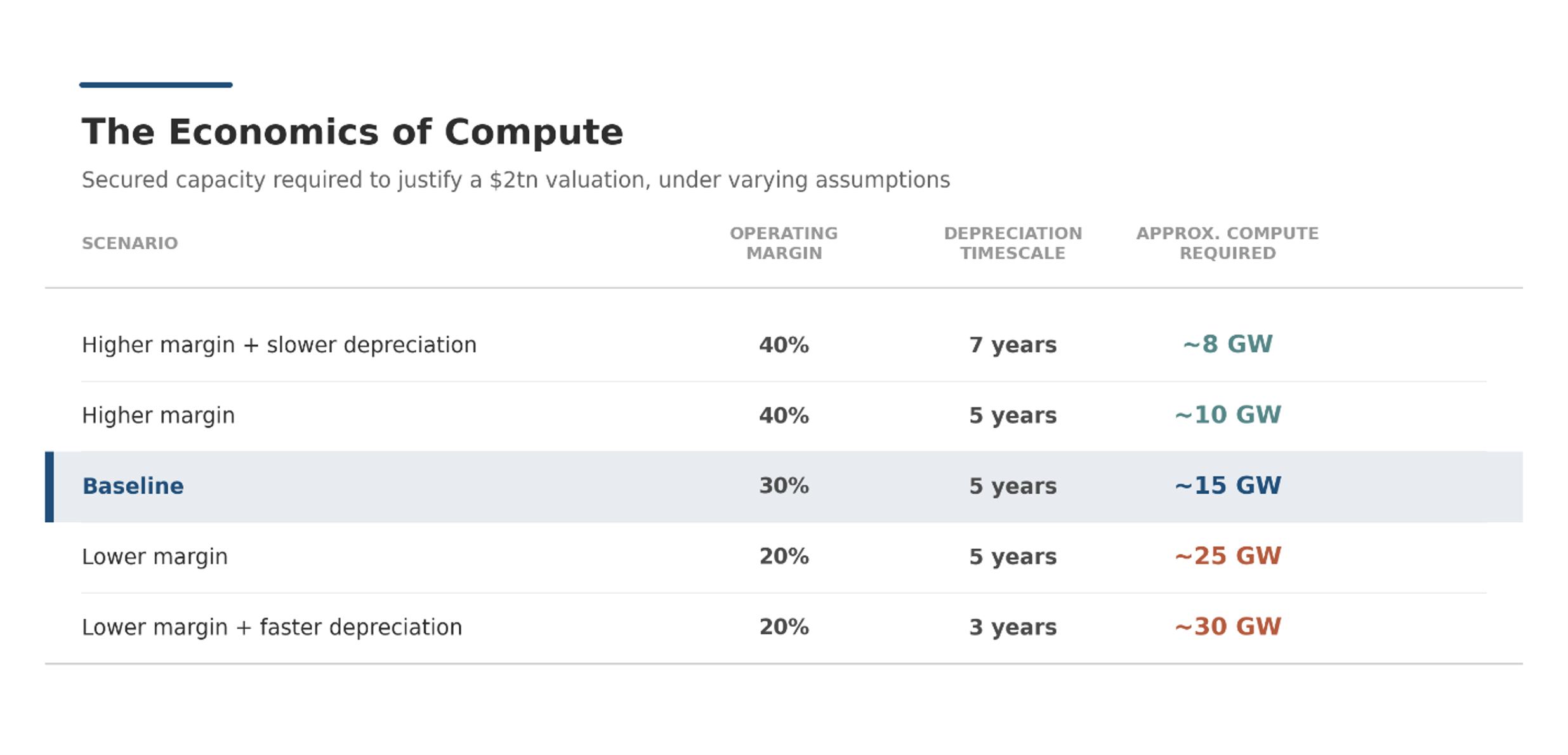
For the pessimists, the size of installed compute needed to achieve earnings similar to the hyperscalers is sensitive to margins and depreciation. If margins decline in response to competition, inferior models or open source, or if compute investments depreciate faster than expected, achieving $70bn in earnings becomes significantly harder. In Table 2 we show the required installed compute base under different margin and depreciation scenarios to support a $2 trillion valuation.
Note that our baseline is conservative: several research houses see significantly higher margins on each GW of installed compute, and the life of older chips keeps extending. Chips run on software, and state-of-the-art LLMs refactor code bases and extract efficiencies no human can replicate, creating significant value. For example, Meta improved its ad placement algorithms with AI, leading to billions in additional revenue. OpenAI’s latest model, Astra 6, was used to optimize its own compute infrastructure for training and serving models, leading to a 2x increase in token throughput. These software improvements are also extending the life of older chips and optimizing their usage across the three major compute verticals: training, inference and agentic harnesses.
The United States still has a significant lead in installed compute, but that lead is at risk. It faces headwinds in permitting, a lack of power infrastructure and strong pushback from communities on datacenter buildouts. Intense demand for compute is pushing investors toward aligned countries that can build faster. For example, Anthropic recently signed a 2.5GW deal in Australia and Google is issuing kangaroo bonds to finance Australian datacenters.
To close, even the lab founders recognize that AI is accelerating more slowly than they would like. Their vision is a form of superintelligence that solves many of the toughest problems facing humanity, with a large positive impact on billions of people. So far, AI is not solving these hard problems at scale; instead it is slowly but surely improving businesses and their profitability by refining processes, workflows and code, enough to support demand growth. The technology will continue to improve and diffuse into the economy, and we suspect bigger announcements will come in various scientific fields5 , showcasing the power of the technology. Remember, this is the worst AI will ever be.
Disclaimer:
Any statements regarding market events, future events or other similar statements constitute only subjective views, are based upon expectations or beliefs, involve inherent risks and uncertainties and should therefore not be relied on. Future evidence and actual results could differ materially from those set forth, contemplated by or underlying these statements. In light of these risks and uncertainties, there can be no assurance that these statements are or will prove to be accurate or complete in any way. All opinions and estimates included in this document constitute judgments of CFM as at the date of this document and are subject to change without notice. CFM accepts no liability for any inaccurate, incomplete or omitted information of any kind or any losses caused by using this information. CFM does not give any representation or warranty as to the reliability or accuracy of the information contained in this document. The information provided in this document is general information only and does not constitute investment or other advice. The content of this document does not constitute an offer or solicitation to subscribe for any security or interest.