Diversification in a Bull Market
The last several years have been constructive for risk assets. Equities rose, volatility stayed contained, and macro conditions were supportive. In that kind of environment, portfolios can feel successful and diversified by allocating to multiple types of holdings making money at the same time. But variety is not necessarily diversification.
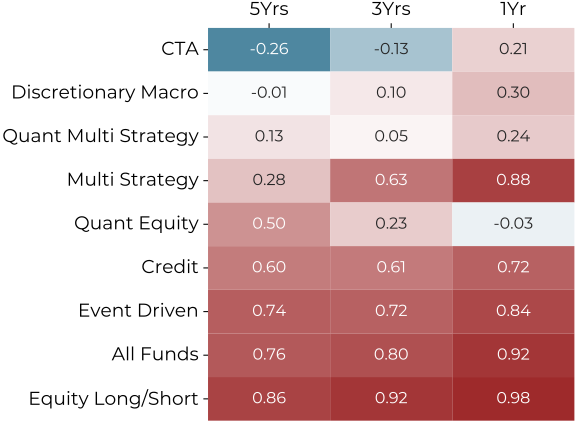
A recent Financial Times article put numbers behind a pattern many investors have sensed: hedge fund returns have been moving increasingly in step with global equities. BNP Paribas research cited in the article showed correlations to the MSCI World rising to their highest in 5 years, with long/short funds nearing 0.98 and the hedge fund industry broadly around 0.92.
This is not meant to be an indictment of hedge funds. It is a reminder that “hedge fund” is a label, not a risk factor. What matters is what actually drives returns. And some hedge fund strategies, such as CTAs and quant multi-strat, have provided praiseworthy diversification benefits with low-to-negative correlations over the past half decade.
What investors want—and what they often buy instead
Investors pursue diversification for a simple reason. Most portfolios are dominated by equity risk. Directly through stocks, and indirectly through credit, private markets, and cyclical exposures. Equity is a sensible long-term growth engine. But the challenge is that its drawdowns can be both deep and rapid, particularly when valuation, leverage, or macro conditions shift.
So investors go looking for diversifiers. In practice, many end up adding strategies that look different structurally but are not that different economically. These can include equity long/short, long-biased hedge funds, credit funds, or absolute return products with positive net exposures. These allocations can be entirely reasonable as return-seeking investments. The issue is that they often contain meaningful equity beta, which is exactly what the investor was trying to dilute.
The drift towards adding more equity beta is understandable. In a bull market, equity-like exposures are easy to defend and hard to abandon, especially when low realized volatility lulls investors into complacency. And career risk stipulates keeping up with peers on a total return basis more than it rewards diversifying exposure.
Why the disappointment is predictable
The unpleasant part of equity-linked diversification is that it tends to reveal itself at exactly the wrong time. Correlations can rise sharply during stress as liquidity thins, risk limits bind, and de-risking synchronizes.
When investors experience that kind of correlation spike, the conclusion is often that diversification failed. More accurately, the portfolio’s diversification premise failed. It held many things, but many things were driven by the same risk.
Investors set out to diversify, add long/short equity, equity-sensitive credit, and other alternatives that quietly embed beta, then discover in a drawdown that the protection was largely illusory. They feel burned, reduce alternatives exposure, and retreat back to the familiar equity-heavy posture that created the original concern.
The problem is not that investors don’t want diversification. It’s that they often buy palatable diversification. Strategies that can be explained in equity terms, benchmarked in equity terms, and expected to participate when equites do well. They are then surprised when those strategies behave like equities when regimes shift negatively.
The uncomfortable answer: use true diversifiers
BNP Paribas’ work also highlighted categories that have remained meaningfully less tethered to equities. Specifically, CTAs (trend-followers) and quant multi-strategy approaches. In the cited data, CTAs showed negative correlation over the longer window and quant multi-strat mildly positive.
The diversification properties of these types of funds is structural. They are driven by different inputs and different opportunity sets such as rates, FX, commodities, volatility, cross-asset relative value, medium-term trends, etc., rather than relying solely on the direction of equity markets.
CTAs can go long or short liquid futures and may benefit in sustained drawdowns when trends persist. And quant multi-strategy portfolios aim to combine multiple independent return sources, and diversify across models and horizons. Both tend to target steady volatility levels, and produce a return stream that is less hostage to the business cycle.
However, these may be harder to sell internally. They can lag in equity melt-ups, and can be difficult to explain because the drivers are not the usual story of earnings, multiples, and credit spreads. When a strategy makes money in rates while losing money in equities, or profits from short exposure during a rally, it can feel counterintuitive to investors accustomed to judging outcomes primarily through an equity lens.
But that discomfort is not a bug, it is the feature. True diversifiers rarely feel intuitive in the same regime that is rewarding the rest of the portfolio.
A cleaner way to think about it
The lesson here is not to avoid hedge funds. It is that investors should separate categories from drivers. If the investor’s objective is resilience to equity drawdowns, then strategies whose primary engine is equity beta will disappoint at exactly the wrong time. Better is to focus on those whose alpha engine is independent from equities.
In long bull markets it’s easy to confuse participation with protection. Diversification is not about holding more things. It is about holding things that remain meaningfully different when markets are not kind.
Figure 1: Hedge Fund Correlations to Global Equities
Disclaimer:
All opinions and estimates included in this document constitute judgments of CFM as at the date of this document and are subject to change without notice. Future evidence and actual results could differ materially from those set forth, contemplated by or underlying these statements. CFM does not give any representation or warranty as to the reliability or accuracy of the information contained in this document. CFM accepts no liability for any inaccurate, incomplete or omitted information of any kind or any losses caused by using this information.